

Abstract
Background
For decades, multinational fossil fuel companies have strategically promoted discourses to obstruct climate action. Initially, the fossil fuel industry publicized communications that denied the role of fossil fuels in climate destabilization. Recently, however, they have advanced nuanced messages to delay climate action and policy. As the climate crisis worsens and calls to phase out fossil fuels intensify, research into the industry has revealed pervasive “greenwashing” and a discrepancy between external messaging on renewable energy and internal operational positions. Corporate annual reports, which are public-facing communications, offer insights into how companies align their internal strategy with their external messaging. Based on a textual analysis of the annual reports of four of the largest fossil fuel companies (ExxonMobil, BP, Shell, and TotalEnergies), this research compares how companies have adapted their communication strategies about renewable energy between 2016 and 2022.
Results
The study reveals that each company focuses on different renewable energy technologies and highlights a variety of positive and negative messages about renewable energy. Since 2016, positive messaging about renewable energy has increased, including narratives on economic benefits, sustainable development, climate action, and strategic business benefits. Negative messaging, including mentions of variable energy intensity, potential business risks, and reductions in companies’ renewable energy businesses, constitutes a small yet consistent part of the communications. This combination of sentiments highlights the benefits of renewable energy while simultaneously undermining the positives with nuanced and negative messages about renewable energy. By promoting fossil fuels as a partner to renewable energy, corporate messages link renewable energy to fossil fuels, reinforcing discourses that slow down the energy transition and expand fossil fuel production with renewable energy development.
Conclusions
Since the 2015 Paris Agreement, the annual reports of fossil fuel companies consistently employed a communication strategy of mixed-sentiment messages that link renewable energy to fossil fuels, particularly fossil gas (i.e., commonly known as natural gas). In this way, companies created and employed doublespeak and delay tactics, obscuring the need to phase out fossil fuels to achieve global climate and sustainability goals.
Background
The combustion of fossil fuels for energy is the largest contributor to rising greenhouse gas emissions, driving the dangerous social, economic, and environmental impacts of the climate crisis. Global production of fossil fuels continues to expand, despite the country-level commitments to reduce emissions included in the international 2015 Paris Agreement [1]. Moreover, scenarios to meet global climate goals require an energy transition where renewable energy constitutes most of the energy supply mix within this decade, and fossil fuels are rapidly phased out [2, 3]. The legally-binding commitments of the Paris Agreement work in tandem with the United Nations Sustainable Development Goals (SDGs) to stabilize the climate, advance a sustainable economy, and improve global social and environmental conditions [4]. Multinational energy companies and countries hosting them have publicly supported the Paris Agreement and the SDGs. Furthermore, large fossil fuel companies have developed plans to meet goals for net-zero emissions, indicating to stakeholders and their shareholders that they are taking action to transition to renewable energy.
In contrast to their current support of international climate goals, the fossil fuel industry has historically used its capital, network power, control of the energy sector, and other industry drivers to influence climate policymakers [5, 6] and affect corporate climate governance in the void left by industry-weakened climate policy [7, 8]. Lobbyists of the fossil fuel industry were present in record numbers at the 2023 United Nations Conference of Parties 28 (COP28), where international policymakers decide the future of climate policy and shape next steps of the energy transition [9]. In addition to their historical role in shaping climate and energy policies, major fossil fuel companies have directly affected climate change impacts through their cumulative greenhouse gas emissions over time. Attribution science studies have traced sea level rise, wildfire intensity, and other climate impacts to historical emissions of large fossil fuel producers [10, 11]. It is clear that large fossil fuel companies play an influential role in determining whether global emissions targets are met [12,13,14]. Multinational fossil fuel companies have a continuing corporate responsibility to mitigate the climate crisis as the main contributors to dangerous climate impacts, and as incumbents in the energy sector transition [15, 16]. Thus, understanding how incumbents in the fossil fuel industry engage with renewable energy is critical for determining the pace and justice impacts of climate crisis mitigation [17,18,19].
Investigations of the fossil fuel industry show a clear discrepancy between companies’ external discourses and their internal positions and actions to address climate crises [20, 21]. Discourses, which refer to the communications and arguments used to shape knowledge and action on a topic, provide mechanisms for creating and affirming power [22]. Companies strategically create and deploy discourses to promote specific narratives and values, and thus maintain a positive public reputation [23]. Discourses of climate delay were identified and categorized into four major types by Lamb et al. [24]. These include redirecting responsibility, pushing non-transformative solutions, abandoning climate action, and emphasizing downsides of climate action. Each of these discourses of delay continues to evolve to downplay the need for climate action.
In addition to companies’ discourses to delay climate action, researchers have identified several communication strategies to obfuscate companies’ climate actions and tame the concept of a renewable energy transition. Schupfer’s [25] analysis of the climate action communications of major fossil fuel companies revealed messaging to obscure their inadequate climate mitigation efforts, while promoting corporate sustainability and responsible corporate action on climate. These companies claim to be supporting long-term climate goals but with little action. Moreover, they refer to fossil fuels as “low-carbon,” and repeatedly state that fossil fuels are necessary for society to thrive. Industry documents obtained through US Congressional investigations exposed how companies use forms of doublespeak, or deliberately misleading communications, to investors and the public. Examples of doublespeak used by fossil fuel companies included ambitious emissions reductions commitments that are inconsistent with the companies’ internal positions, publicly planning to comply with the Paris Agreement while expanding fossil fuel activities, promoting fossil gas as a clean fuel, and supporting emissions reductions policies while lobbying to undermine climate legislation [20]. Doublespeak can be deployed by framing euphemistic language against perceived negatives to make the unacceptable, such as continuing fossil fuel use, seem reasonable, particularly when the audience faces uncertain knowledge or misinformation about a topic [26,27,28]. Research on the fossil fuel industry shows their strategic use of discourses to weaken and co-opt the idea of a renewable energy transition into a trasformismo, a process by which powerful organizations prevent disruptions of their power by domesticating opposing ideas [29].
To understand how the industry is responding to the need for a global renewable energy transition and the phase out of fossil fuels, it is urgent to identify specific discourses used by the fossil fuel industry during the nascent energy transition. This study aims to identify how four major fossil fuel companies externally communicate about the renewable energy transition through corporate annual reports. This study does not consider company actions in the energy transition, nor does it seek to measure the impact of company communications. In this article, we expand on Lamb et al.’s [24] climate delay framework by proposing a new framework synthesized from discourses of climate delay [24], patterns of doublespeak documented within the fossil fuel industry [20], and fossil fuel company communications hiding insufficient climate action [25]. Analysis of the renewable energy messaging within the annual reports of major fossil fuel companies informs the expanded framework.
Text analysis of the annual reports of multinational fossil fuel companies enhances understanding of how industry leaders are engaging with the renewable energy transition. These annual reports have been analyzed to evaluate company transition strategies, sustainable development efforts, and renewable energy investment [12, 21, 30,31,32,33,34], and to assess sustainability and corporate social responsibility (CSR) communications [16, 35]. The annual reports of fossil fuel companies have not yet been analyzed to understand the messaging companies use when communicating about renewable energy to stakeholders, despite the influential role corporate communications play in shaping stakeholder perceptions about developing technologies [36].
This study fills this gap by answering the following research question: how frequently and with which sentiment are renewable energy technologies referenced in the annual reports of fossil fuel companies? Text analysis of companies’ yearly reports shows how different fossil fuel industry leaders have adapted their narratives about renewable energy over time. Furthermore, content analysis has been employed across international business research to study annual communications [37]. Sentiment analysis, which characterizes the tone of messaging, has been applied to business studies to examine how emotions within corporate communications affect investor confidence and firms’ future performance expectations [38]. Content and sentiment analysis of companies’ annual reports accordingly provide a thick, in-context understanding of the messages most often used when fossil fuel companies communicate about the renewable energy transition.
The article proceeds as follows: First, it provides background on the roles of fossil fuel companies in climate policy, their engagement with renewable energy, and corporate annual reporting. Next, it presents methods for identifying, coding, and analyzing renewable energy messages against the discourses of doublespeak, delay, and obscuring the insufficient climate action framework. The results section presents trends in renewable energy communications over time, highlighting the major themes of renewable energy messaging and where these communications align with discursive strategies to stall the energy transition. The discussion explores the implications of companies’ renewable energy messaging to stakeholders in the wider context of the industry’s current ethics and business performance, and how fossil fuel companies are affecting renewable energy transition and climate action through written discourses. The limitations of the research are discussed, concluding with future research directions.
Fossil fuel companies and renewable energy
Most multinational energy companies have core business interests in fossil fuels. The renewable energy transition threatens the survival of the global fossil fuel industry as it is now, yet al.so offers companies the opportunity to transform their businesses into clean energy companies [18, 39]. Beyond the false binary of resisting transition or business transformation, fossil fuel companies also have the power to strategically use renewable energy to hedge their decarbonization risks and shape an energy addition, in which renewable energy merely supplements and does not replace fossil fuels, thereby reinforcing companies’ existing fossil fuel interests [31]. Renewable energy development without phasing out fossil fuels and implementing measures to redress current energy system injustices represents an unjust energy addition, not a just energy transition [40]. We recognize these potential pathways—business-as-usual resisting energy transition, business transformation to clean energy corporations, and rebranding as integrated energy companies with both renewable and fossil energy activities —ignore conversations that question the sustainability of capitalist economies; however, this is outside the scope of the article.
This analysis considers how multinational fossil fuel companies engage with the renewable energy transition in their external communications. These companies currently show public support for a version of the renewable energy transition; one which directly supports their fossil fuel businesses and, in reality, is not a transition away from fossil fuels [41,42,43]. Growing political and public calls to accelerate energy transition, and a global movement for a fossil fuel non-proliferation treaty, are pressuring companies to recalibrate their businesses to renewable energy [44]. However, the fossil fuel industry’s public support for the renewable energy transition is a strategic addition to the industry’s extensively coordinated efforts to initially deny climate change, and now acknowledge climate crisis and work to obstruct climate policy through lobbying, advertising, and other forms of communication [45,46,47,48]. Recent studies of fossil fuel companies’ engagement with the renewable energy transition have shown a fundamental discrepancy between their climate goals and their climate actions [21, 30, 31].
Corporate communication: annual reports
Large companies deploy a range of external corporate communications, including annual reports, social media posts, advertising, and other messaging, to create and maintain reputation, drive business strategy, and support organizational and management changes [23, 49]. Annual reports are a critical part of a company’s communication strategy, allowing businesses to curate and disseminate financial statements and descriptive, non-financial information about company performance to investors, regulators, and other stakeholders. These reports aim to provide company stakeholders with a measure of transparency about corporate actions, facilitating corporate accountability to investors [50]. The annual reports of multinational corporations are shaped by different legal regimes, such as securities regulations and civil and transnational litigation, and these reports fulfill multiple other business aims, including responding to changing stakeholder values, exposing and reducing market risks, and speaking to broader markets [51, 52]. Thus, annual reports are a rich archive capturing how firm messages align with business practices, company culture, and organizational change [53].
The reporting requirements of different countries make the annual reports of multinational companies more complex. These companies are publicly traded on several international stock exchanges and must comply with numerous disclosure regulations of the countries in which they are headquartered, operate, and are listed [54]. Increasingly, global companies are voluntarily adopting a format for annual disclosures called integrated reporting, featuring combined financial, sustainability, and ESG metrics. However, not all fossil fuel companies have adopted this approach. Instead, some companies produce standalone sustainability and CSR reports, in addition to the regulated, descriptive, and financial disclosures within annual reports [55].
Annual reports can contain information on the company’s environmental, social, and corporate governance (ESG), CSR, and sustainability activities, including renewable energy adoption [56, 57]. This information is important to inform corporate stakeholder decision-making [58], and is differentially regulated by the US, UK, and the EU. The EU has fortified its reporting rules with a corporate sustainability directive requiring companies to report environmental impacts and climate-related risks [59]. Since Brexit, the UK has been developing its own requirements for companies to report their climate transition plans [60]. The US Securities and Exchange Commission (SEC) has adopted rules to standardize and mandate climate disclosures [61]. Fossil fuel companies voluntarily track how their sustainability and CSR reporting aligns with sustainability reporting standards of the Global Reporting Initiative (GRI), Sustainability Accounting Standards Board (SASB), and International Petroleum Industry Environmental Conservation Association (IPIECA), with the GRI standards being the most common across global companies [62].
Since the non-financial reporting of global fossil fuel companies faces differential regulation and is not standardized, a range of information about company social, environmental, and sustainability activities can be included in annual reports [16]. Furthermore, non-financial disclosures can reflect corporate priorities and marketing approaches [63]. Unverified green marketing claims are considered to be greenwashing, a form of corporate social irresponsibility that can negatively affect firm performance owing to deep reputational damage [64, 65]. Business transitions, such as the renewable energy transition, increase company exposure to new risks. This exposure can incentivize companies to reframe uncertainties in annual disclosures [66] and may lead to greenwashed communications to shareholders. For example, recent corporate accountability investigations have revealed that Shell, ExxonMobil, and other global companies have orchestrated, and benefited from, the greenwashing of hollow carbon offset schemes with no direct emissions reduction benefits [67,68,69,70,71].
Increasing shareholder activism and investor initiatives are pressuring companies to meet more stringent emissions reduction goals by transitioning to renewable energy sources [72]. Studies of the fossil fuel industry’s current climate communications reveal strategic discourses to delay and distract climate policy [20, 24, 25, 73]. At the same time, corporate climate commitments are increasingly important to understand the outcomes of multilevel climate governance [7, 74]. The outsized influence of a few shareholders on the fossil fuel industry indicates communications in annual reports may be an important mechanism to sway those who impact corporate climate governance [75, 76].
Methods
We analyzed the annual reports of Shell, BP, TotalEnergies, and ExxonMobil from 2016 to 2022. These multinational fossil fuel companies were selected based on their large market capitalization, significant historical influence on climate discourse, a key role of responsibility in contributing to global greenhouse gas emissions, and the varied regulatory context of their headquarters’ locations in the UK, EU, and US (shown in Table 1). These companies represent four of the world’s biggest multinational fossil fuel companies, according to each company’s 2024 website. Shell operates in more than 70 countries, BP and ExxonMobil in more than 60 countries, and TotalEnergies in about 120 countries [77,78,79,80]. The headquarter of Shell was in the Netherlands until it moved to the UK in 2021, BP remains headquartered in the UK, ExxonMobil’s headquarters are in the US, and TotalEnergies’ headquarters are in France (EU). Chevron, a large US-based fossil fuel company, was excluded from this analysis because the intent of the research was to compare four companies headquartered in four different countries (prior to Shell moving its headquarters to the UK). We included ExxonMobil as the US-based fossil fuel company in our study because it had more detailed annual reporting during the study period and was thus more comparable to the UK and EU companies, which have more comprehensive annual reports. Each of the host countries has ratified the 2015 Paris Agreement’s goals on climate change.
This article analyzes 28 annual reports from the four multinational fossil fuel companies in the period following this international commitment to reduce greenhouse gas emissions. Through fiscal years 2016 and 2022, Shell, BP, and TotalEnergies released detailed annual reports once a year for a total of 21 annual reports [88,89,90]. Companies typically publish their yearly reports during the first quarter of the next fiscal year; for example, the 2022 annual reports were published by companies in early 2023. The annual reports from Shell, BP, and TotalEnergies spanned several hundred pages, with the largest report containing more than six hundred pages. During this time period, ExxonMobil released a total of 7 annual reports: summary annual reports with standalone financial reports for fiscal years 2016 to 2019, and more comprehensive annual reports for their 2020 through 2022 fiscal years [91]. ExxonMobil’s most comprehensive annual reports, with fewer than two hundred pages, were short compared to the annual reports of its UK and EU peers.
The text analysis software NVIVO 12 Pro was used to inductively code and analyze mentions of renewable energy across the 28 annual reports. Content analysis examined the frequency of renewable energy and fossil fuel keywords’ usage in companies’ annual reports. The frequency of renewable energy references was compared to the frequency of fossil fuel references to allow for a consistent comparative metric across reports. Content analysis further assessed where references to renewable energy appeared within the different sections of the annual reports.
Text queries made with the clean energy keywords modified from the GRI [92] and Li et al. [42] identified the renewable energy technologies targeted by fossil fuel companies. Table 2 shows the keywords used to search for renewable energy and fossil fuels across company annual reports. While this study included biofuels and biomass following the GRI definition of renewable energy, the authors acknowledge research showing biofuels and biomass produced a carbon-positive impact on US, UK, and EU greenhouse gas emissions [93,94,95]. Iterative text analysis revealed that the four companies use the term “biofuel” more commonly across their annual reports; as a result, the following content analysis focuses on references to biofuels. We omitted hydrogen fuel from the study because of difficulties in isolating text about solar- and wind-derived hydrogen from text about gas-derived hydrogen, hydrogen sulfide, and other hydrogen compounds. Technologies and materials associated with renewable energy, such as metals for battery storage, are outside the scope of this analysis.
Sentiment analysis identified contextual messages and themes surrounding mentions of renewable energy, by assessing whether references to renewable energy technologies were positioned by companies in a positive, negative, or neutral context (as shown in additional material 1). Positive renewable energy mentions included the presence and collocation of words attributing company value, such as “asset,” “solution,” or “key portfolio event.” Negative mentions included words attributing negative value, such as “intermittent” or “losses” or “liability,” or when the renewable energy was presented as an inviable alternative to fossil fuels. Neutral mentions were identified when the renewable technology was mentioned without a specific positive or negative sentiment, or when it was unclear if sentiment was attached to the renewable energy or a partnering technology like hydrogen. The codebook was developed by inductively coding the companies’ 2021 annual reports to find which renewable energy technologies are targeted by the four fossil fuel companies. The codebook was tested, and intercoder reliability was established, by two authors co-coding the 2018 annual reports from three of the four companies, representing more than 10% of the dataset [96]. For co-coding, each author coded the renewable energy reference as being within a positive, neutral, or negative context. Instances of disagreement were discussed to understand the sentiment received from company messages. Finally, the codebook was applied to mentions of renewable energy in 28 annual reports. The intercoder percentage agreement yielded from this iterative process is over 98%.
We adapted and synthesized the discourses of climate delay [24], fossil fuel industry messages of doublespeak [20], and fossil fuel companies’ communications to hide their minimal climate actions [25] into a new framework based on predominant renewable energy communications in companies’ annual reports (Fig. 1). Renewable energy messages within the 28 annual reports were analyzed against the adapted framework to reveal how companies develop and use strategic discourses in their annual reports since the 2015 Paris Agreement.
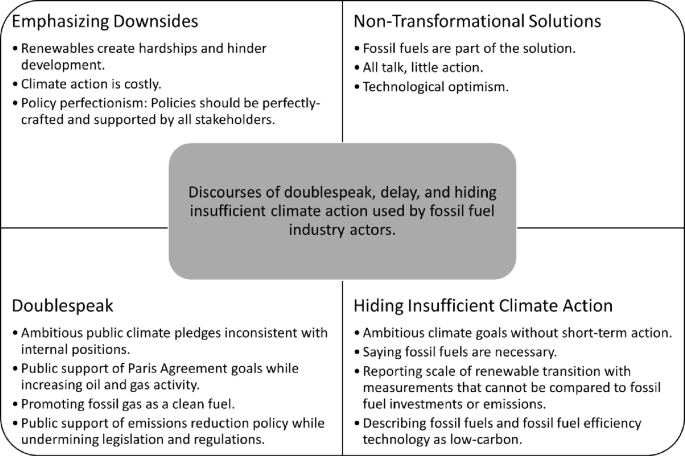
Discourses of doublespeak, delay, and hiding insufficient climate action used by fossil fuel industry actors. Discourses include emphasizing downsides of climate action and renewable energy transition; promoting non-transformational solutions; using doublespeak, or misleading communications, about energy transition and their climate commitments; and hiding their insufficient climate action. Adapted from [20, 24, 25].
Results
This study analyzed a total of 2,273 mentions of renewable energy across the four companies’ 2016 through 2022 annual reports. Mentions of renewable energy technologies increased in the companies’ annual reports over time, except for US-based fossil fuel company, ExxonMobil, which reduced references to renewable energy in its annual reports during this period. TotalEnergies increased its mentions of renewable energy most dramatically during this time. References to oil, coal, and gas were more frequent than mentions of renewable energy technologies for all four companies, reflecting their core business interests in fossil fuels (shown in Fig. 2).

Absolute mentions of renewable and fossil fuel energy in company annual reports, 2016–2022.
The four companies frequently mentioned biofuels, solar, and wind in their annual reports, while hydropower, geothermal, wave, and tidal energy were rarely referenced. Wave and tidal energy were not mentioned in company annual reports, while geothermal energy was noted a few times within companies’ renewable energy definitions and transitional scenarios. Shell and TotalEnergies mentioned hydropower increasingly within their 2019–2022 annual reports, yet these references were proportionally minimal compared to hundreds of references to solar, wind, and biofuels. This analysis only considered mentions of solar, wind, and biofuels because they were frequently referenced in the companies’ 2016 through 2022 annual reports.
The results indicate the four multinationals had diverse engagement with renewable energy, with companies focused on specific technological niches. Whilst Shell and ExxonMobil had a focused interest in biofuels, BP’s interest was in wind energy, and TotalEnergies’ was in solar power generation (Fig. 3). The UK and EU-based companies (e.g., Shell, BP, and TotalEnergies) maintained these targeted interests since 2016, and only increased references to other renewable energy after their 2020 annual reports. ExxonMobil kept its focus on biofuels, showing minimal references to solar and wind in its annual reports since 2016.
The reports of the four companies showed varying attempts to integrate descriptive, non-financial information about renewable energy into the financial statements and other sections of annual disclosures (seen in additional material 2). Shell, BP, and TotalEnergies expanded mentions of renewable energy from the strategic report section to the governance report, notes on financial disclosures, and other sections of their annual reports. ExxonMobil expanded its few mentions of renewable energy to different annual report sections over time, yet its references to renewable energy were fewer overall compared to those of Shell, BP, and TotalEnergies.

Solar, wind, and biofuel references in fossil fuel company annual reports, 2016–2022.
Solar
Solar energy was mentioned most frequently compared to wind and biofuels in companies’ annual reports. Most references to solar power displayed positive sentiment, followed by neutral mentions, and a small yet consistent part of negative messages (Fig. 4).
Positive messages about solar energy emphasized company investments, ownership, and operations across the solar value chain and company leadership in solar markets. Companies communicated the ability of solar energy to reduce greenhouse gas emissions and advance energy transition, as well as how company activities in solar power help meet global climate goals. In addition, companies offered examples of solar energy powering company internal operations as well as meeting customer needs. They highlighted the use of solar power for sustainable development, and emphasized how solar businesses diversify company portfolios and enable strategic partnerships. Positive messages about solar energy also highlighted its competitive cost propositions and expected growth opportunities in solar energy demand over time.
Neutral messages about solar energy discussed how it can complement and integrate with the variety of company operations in fossil fuels, and produce green hydrogen. The four companies communicated how solar businesses are segmented with gas businesses in their organizational structures. The companies also deliberated pending approvals and developments in respective solar energy ventures, and included cautionary statements about the projected business performances in solar power generation. Furthermore, companies provided risk statements about how advances in technology would support solar energy adoption and degrow fossil fuel demand. Neutral mentions of solar power also included generic assertions grouping solar energy with wind, biofuels, fossil (natural) gas, hydrogen, carbon capture, and other energy technologies. TotalEnergies uniquely promoted employing solar energy to power bio-refineries and remediate non-operational industrial sites.
Negative messages about solar energy discussed intermittency and promoted fossil gas and technological advancements as partners of solar energy. Companies reported information on increasing solar energy costs during the return to economic growth following the global COVID-19 pandemic, and various business losses related to company solar activities. Significantly, negative messages about solar power included information on divestment from solar businesses, despite commitments and growing pressure to expand renewable energy operations.
Biofuels
Biofuels were the second most frequently mentioned renewable energy in companies’ annual reports after solar power. Messages about biofuels mostly displayed positive sentiment, followed by those with neutral, and finally negative sentiment (Fig. 4).
Positive messages about biofuels mentioned company investments, ownership, and operations in biofuels and company positions in biofuels markets. Reports communicated how company biofuel activities helped decarbonize sectors dependent on liquid fuels; met customer energy needs, global climate goals, and regulatory requirements; as well as supported sustainable development and the energy transition. Companies promoted biofuels’ ability to blend with and reduce emissions of fossil fuel products, and emphasized how biofuels facilitated strategic partnerships and diversified energy portfolios. Moreover, companies provided information about certifying their respective biofuel operations and feedstocks against international sustainability standards and developing biofuels from varied and potentially circular feedstocks. Positive references to biofuels projected an expected growth trajectory in biofuel demand and expressed how US and EU renewable fuel policies have grown biofuels markets. Companies further underscored how fossil fuel industry expertise contributed to biofuel processing technologies.
Neutral messages promoted the use of biofuels with fossil gas and/or hydrogen as the dominant liquid fuels of the energy transition, and illustrated how biofuels are organized with company businesses in gas, chemicals, lubricants, and/or other oil products. Companies included information on their respective upcoming developments in biofuel businesses, qualified with cautionary statements about future performance in biofuels, risk statements about the growth in biofuels negatively affecting historically linear oil demand trajectories, and statements emphasizing that biofuels are subject to a range of regulations. In addition, neutral mentions of biofuels emphasized how technological advancements could improve biofuel operations, and expressed the need for tandem investment in the mature energy system and an energy system based on biofuels, renewable electricity, and other technologies. Neutral messages about biofuels were also observed as hedging the emissions reduction benefits of biofuels across the companies’ Scope 1, 2, and 3 emissions reporting. Scope 1 emissions are greenhouse gases directly emitted by the company, whereas Scope 2 emissions come from purchased energy used by the company, and Scope 3 emissions are associated with company operations along its value chain [97]. Companies mentioned the benefits of biofuels in helping reduce Scope 3 emissions while also underscoring how biofuels conversely increase their Scope 1 and Scope 2 emissions. These communications revealed companies had discretion to include biofuels emissions in reported Scope 3 emissions, and exclude biofuels emissions from reported Scope 1 and/or 2 emissions.
Negative messages about biofuels remarked upon the variable energy intensity of biofuels based on feedstocks and processing. Companies related how costs and feedstock availability could impede biofuel production; for example, feedstocks could increase competition for local land and water resources, as well as face exposure to land-based risks like fires and droughts. Additionally, companies raised concerns about biofuel production chains potentially facing human rights, labor rights, and conservation rights challenges. Negative messages about biofuels included examples of unsafe biofuel operations and ensuing workforce hazards, and described biofuels as a potential company liability. Companies also mentioned loss cost metrics incurred from biofuel operations, how biofuel mandates could negatively impact their downstream businesses, and predicted a decline in biofuel demand in some markets.
Wind
Wind power was mentioned the least across companies’ annual reports compared to solar and biofuel generation. Most mentions of wind energy displayed positive sentiment, followed by mentions of wind with neutral sentiment. Negative messages about wind were consistent across the annual reports of the UK and EU-based companies (Fig. 4).
Positive messages about wind discussed company investments, ownership, and operations in onshore and offshore wind operations, and leadership in wind energy markets. Companies spoke about the ability of wind energy to reduce greenhouse gas emissions and facilitate energy transition, and how their activities in wind energy could help meet climate and sustainable development goals. Annual reports expressed the safety of wind operations for workers, wind energy’s competitive cost benefits, and expected growth trajectories in wind energy demand. Companies conveyed how wind energy supported strategic partnerships and diversified energy portfolios, and how wind power met customer clean energy demand. Moreover, companies promoted the expertise of the fossil fuel industry in building offshore wind energy platforms and the potential for offshore wind generation to replace offshore oil drilling. Shell’s annual reports uniquely featured messages celebrating the cultural link between its Anglo-Dutch heritage and wind power activities.
Neutral messages discussed how wind energy can integrate with fossil fuel operations, how wind activities are segmented with gas in the companies’ organizational structures, and the ability of wind energy to produce green hydrogen. Companies communicated potential developments in wind activities, along with cautionary statements about their projected performance in wind power, risk statements about advances in wind generation technology and their impacts on fossil fuel demand, as well as statements about wind energy being subject to a range of regulations. Neutral messages also included generalized statements about wind power that grouped the renewable energy with other energy technologies.
Negative messages about wind energy mentioned the intermittency of wind and advocated for fossil gas and technological advancements as complements to wind energy generation. Companies mentioned increasing costs of wind energy after the global COVID-19 pandemic, business losses related to wind activities, and notably, disposals of wind businesses.

Sentiment of solar, wind, and biofuel mentions in fossil fuel company annual reports, 2016–2022.
The thematic frames used with positive, neutral, and negative messages are shown in Table 3. The combination of positive and negative messages about renewable energy acted as a form of doublespeak, pointing out the economic benefits, sustainable development, climate action, and business advantages of renewable energy, while also communicating the high costs and intermittency of renewable energy sources, divestments from renewable energy businesses, and potential environmental and workforce harm from renewable energy operations. Neutral messages implied renewable energy needs to integrate with fossil gas and novel technologies to be dependable and competitive, promoting non-transformational action. Neutral messaging also obscured companies’ inadequate climate actions by claiming fossil fuels are necessary for the energy transition and sustainable development, and describing renewable energy integrated with fossil fuels and fossil fuel efficiency technologies as clean (Fig. 5). Discourses of delay, doublespeak, and hiding insufficient climate action were deployed through single, and/or mixed, sentiment messages.
Discussion
This study applied text analysis to reveal how annual reports are a valuable source of data for assessing the ways in which companies create and employ renewable energy discourses to influence the energy transition, particularly for stakeholders. Table 4 shows examples of positive, neutral, and negative messages about renewable energy across the companies’ 2020–2022 reports. The combination of positive, neutral, and negative communications about renewable energy created nuanced discourses that work together to delay energy transition.
We expand on the discourses of the climate delay framework [24], fossil fuel companies’ strategies to obscure their deficient climate actions [25], and industry patterns of misleading doublespeak [20] to propose a new framework based on renewable energy messages in the annual reports of multinational fossil fuel companies since the 2015 Paris Agreement (seen in Fig. 5). Discourses that focused on the downsides of renewable energy opposed the positive statements companies made about renewable energy and helped reveal the use of doublespeak. Examples of doublespeak in companies’ reports used euphemistic, nuanced, and negative language to promote conflicting messages about renewable energy. This created a type of cognitive dissonance by which the unacceptable, such as continued fossil fuel use, was made to seem acceptable [26]. Discourses that promoted non-transformational solutions contained neutral and negative statements about renewable energy, which connected fossil fuels to renewable energy in companies’ operations and organizational structures. In contrast, discourses that hid insufficient climate action used nuanced language that was difficult to validate as true, such as messages presenting an industry perspective as fact, or partially true statements describing fossil fuels and related technologies as “low-carbon.” The discursive strategies of large fossil fuel companies advanced and capitalized on uncertainty about the renewable energy transition to maintain their fossil capital [98].
Emphasizing downsides & doublespeak
Companies deployed mixed-sentiment messages about renewable energy benefits and tradeoffs, a nuanced form of doublespeak which euphemistically highlights company positions about the positives of renewable energy while emphasizing potential downsides of renewable energy. As examples of these discourses, BP’s 2021 annual report indicated that one of the company’s goals is to have a leading position in offshore wind and grow the company’s solar activities:
In offshore wind, in 2021 BP was one of the top developers in terms of acreage. We have built scale in two of the most attractive markets, US and UK. In Scotland for example, these positions in offshore will enable us to leverage integration opportunities with green hydrogen, EV mobility and power trading as we build the business. We are building a global leadership position in offshore wind.
In solar, we continue accelerating growth through our Lightsource BP partnership and developing our 9GW portfolio of US solar projects which was acquired in July 2021. Since BP’s investment in late 2017, Lightsource BP has brought 53 projects to FID at weighted average expected internal rate of return (levered) of 8–10% and entered 14 new countries.
The same report promoted natural gas and green hydrogen as integrated complements to wind- and solar-generated electricity, emphasizing that electricity generation from solar and wind can be variable.
We also look for integration across multiple products and services and multiple geographies and customers. For example, we explore ways to couple renewable power supply from wind and solar with gas fired generation and investments in green hydrogen to address intermittency, which can offer customers more reliable electricity [89].
The use of positive and negative messaging revealed instances where companies highlight downsides of renewable energy and use doublespeak. Annual reports described renewable energy projects reliably powering households and fossil fuel industry operations, while also promoting the narrative that renewable energy needs to be paired with fossil gas and other technologies to be dependable and cost-competitive. Other examples of doublespeak observed in companies’ reports included statements emphasizing expected growth in solar, wind, and biofuel demand trajectories, in contrast to disclosures in TotalEnergies’ 2022 report, which indicated biofuel demand is expected to decrease in some markets. Furthermore, generalized statements about renewable energy diluted the specific benefits of solar, wind, and biofuel power. In doing so, companies underscored a range of renewable energy capabilities and thus confused the values and roles of renewable energy in the energy transition. This messaging strategy matched companies’ responses to shareholder activism, analyzed by Tillotson et al. [76], which emphasized the importance of fossil fuels and hedging technologies to development, while falsely reflecting shareholders’ climate concerns.
Fossil fuel companies reprioritized their renewable energy businesses since 2022, in line with their deficient climate actions. Shell and ExxonMobil divested from their biofuel projects [99, 100], and TotalEnergies has sold more of its renewable portfolio [101, 102]. Shell also stepped back from leading new offshore wind projects and reduced staff in its Low Carbon Solutions division [103]. In early 2025, BP’s CEO claimed the transition has been slower than expected, partly because of changing attitudes about renewable energy; as a result, the company reduced investments in renewable energy transition while prioritizing shareholder profits with increased oil and gas investments [104, 105]. Such activities suggested these companies may only be pursuing incremental actions into renewable energy and fulfilling claims of delayed energy transition. Significantly, divestments from renewable energy businesses occurred despite companies reporting record profits in 2023, and research indicating that companies’ climate plans and efforts fall short of the action needed to meet the Paris Agreement goals [21, 106, 107]. TotalEnergies continued its non-transformational strategy to boost fossil fuel profits, which company leadership stated would be invested in renewable energy development. However, their recently launched wind project provided clean electricity to their offshore oil and gas platforms, indicating the company’s renewable energy development was prioritized to decarbonize their existing fossil fuel business [108, 109]. As a result, companies’ actions to increase fossil fuel profits over renewable energy development have grown the fossilized capital, or concretized power, of major fossil fuel producers [110].
Non-transformational solutions & hiding insufficient climate action
Individual- and mixed-sentiment messaging in companies’ annual reports linked renewable development to fossil fuels, a non-transformational action to delay energy transition. This messaging also communicated that fossil gas is necessary for the energy transition, a discursive strategy to hide inadequate climate action. Phrases like “low- and zero-carbon” used to describe different renewable and fossil energy sources in the same sentence obfuscated companies’ minimal action in renewable energy and facilitated the greenwashing of fossil fuels (as seen in Table 4).
Companies’ positive messages illustrated how fossil fuel expertise, operations, and business strategy contributed to renewable developments in areas like offshore wind platform construction and biofuel refining. Neutral messages indicated renewable energy businesses were segmented with gas and/or refinery businesses, interlinking renewable and fossil fuel developments within companies’ organizational structures. As an example of these discourses, TotalEnergies’s 2022 report promoted their goal to have a leading position in wind and solar energy production, and stated the company’s core expertise supported development of low-carbon energies critical for the energy transition:
Its goal is to build an Integrated Power segment with a return on average capital employed higher than 10% and to rank among the world’s top five providers of solar and wind energy by 2030, with gross capacity of 100 GW and an interim target of 35 GW by 2025 (the Company reached 17 GW as of yearend 2022). Second, the energy transition depends on the development of new, low carbon energies (biofuels and biogas, clean hydrogen and synthetic fuels combining hydrogen and carbon) that TotalEnergies has the core skills to produce.
When discussing TotalEnergies’ eligible activities to report under the EU Taxonomy regulations, the company’s 2022 annual report showed how the company segmented its renewable energy activities with its fossil gas businesses, and how the company’s biofuels activities were organized with its fossil fuel refining and chemicals segment:
The Eligible Activities reported under the line Electricity and renewables include renewable energy activities and electricity generation from natural gas of the Integrated Gas, Renewables & Power segment, as well as construction and operation of electric charging stations of the Marketing & Service segment. The Eligible Activities reported under the line Biofuels and chemicals include the production of biofuel for transportation, the manufacture of basic organic chemicals and the manufacture of basic plastic materials of the Refining & Chemicals segment.
The same report described natural gas as a transition fuel necessary to address intermittent solar and wind energy:
TotalEnergies has embedded the changing energy markets into its strategy by investing in renewables and electricity, developing the production of biofuels, biogas and low-carbon hydrogen, favoring the use of natural gas, the transition fuel whose flexibility offers a lower carbon alternative to coal for electricity production and helps to mitigate the intermittency of solar and wind energies, targeting its investments in low cost and low-emission oil, and developing nature-based carbon storage solutions as well as CO2 capture and sequestration. [90].
Negative messages about renewable energy intermittency, variable carbon intensity, and excessive cost promoted fossil fuels like fossil gas as a complement to renewable energy, or as a continuous alternative. By describing solar and wind energy as intermittent, fossil fuel companies shifted attention away from the fact that these energy sources are inexhaustible, and instead advertised fossil gas as necessary to pair with solar and wind power [111]. This tactic aligned with messaging strategies used on companies’ social media platforms [112,113,114,115] and member trade association documents [116] which repeatedly pushed fossil (natural) gas as a clean transition fuel [20, 117]. The discursive strategy to promote gas as a viable transition fuel coincided with research revealing that major fossil fuel companies have formed a network of coordinated joint-ventures in liquid natural gas (LNG) production, including Shell, BP, TotalEnergies, and ExxonMobil [118]. By advertising fossil gas as a transition fuel, fossil fuel companies contributed to broader industry narratives that falsely promoted fossil fuels as part of the solution to address the climate crisis [119].
Companies’ renewable communications & implications for global climate and sustainable development goals
This analysis found the EU and UK based companies increasingly mentioned renewable energy in their yearly non-financial disclosures, while the US based company reduced references to renewable energy in its annual reports since 2016. References to fossil fuels in yearly reports dramatically outweighed the number of references to renewable energy for each firm, despite the number of positive statements companies made about renewable energy (Fig. 2). Likely, companies’ investments in renewable energy are not proportional to the frequency of positive messaging in annual reports about their role in advancing the renewable energy transition. Analysis of post-2024 energy investment trends indicated the sector continued to prioritize fossil fuel investments despite climate commitments, with low-emissions fuel investment comprising about 3% of total fuel investment, and 97% going to fossil fuels [120]. These companies used non-financial disclosures to promote their core business interests in fossil fuels and temper any positive communications about renewable energy.
We further identified that the EU and UK headquartered companies have increased the number of references to renewable energy across sections of their annual reports over time. By contrast, the US fossil fuel company slightly expanded mentions of renewable energy within its annual report sections, yet retained minimal renewable energy references comparatively (illustrated by additional material 2). The increase of renewable energy mentions in Shell, BP, and TotalEnergies’ annual reporting suggested the EU and UK-based fossil fuel majors may have faced enough regulatory pressure to lead the slow integration of non-financial and financial reporting in the fossil fuel sector. However, integrated reporting has not been the historical norm for these companies. With a lack of consistent, integrated sustainability and financial reporting, it remains unclear how companies are leveraging financial data to pursue sustainability strategies across their operations.
The increasing messaging about renewable energy in companies’ annual reports since the 2015 Paris Agreement has become a strategic addition to the industry’s myriad of tactics to at first deny, and now acknowledge the climate crisis, while working to undermine climate action [121]. The results aligned closely with the post-2015 narrative shifts to “alongside renewables” and “net-zero business” observed by Gentile and Gupta in Shell’s sustainability reports [122]. Our analysis revealed that the incumbent companies take minimal steps into specific, renewable energy niches (Fig. 3), similar to the gradual, green engagement approach taken by a leading Norwegian fossil fuel company after 2018 [123].
This study indicated that the EU and UK headquartered companies appeared to be quicker to shift operations into renewable energy than their counterpart ExxonMobil in the US, despite similar public communications on emissions reduction goals. This could be because of the EU’s leading role in climate and environmental regulation and increasingly stringent corporate non-financial reporting regulations [56, 124] and lawsuits in European courts identifying companies’ ongoing climate harms and their responsibility to reduce emissions [125, 126]. To understand the different renewable energy engagement and communications of US-based ExxonMobil, it is important to recognize the US fossil fuel industry is intricately linked to its national political and policy-making environment. Consequently, the US fossil fuel industry has enjoyed weaker corporate environmental regulation [57, 127, 128].
Furthermore, messaging in the annual reports of fossil fuel companies revealed the EU and UK headquartered companies were integrating solar, wind, and biofuel energy sources with fossil fuels. In contrast, the US fossil fuel company was exploring biofuels while maintaining its fossil fuel interests. Our study showing companies’ engagement with certain renewable energy technologies closely mirrored their renewable energy niches as found in a study of their X (formerly Twitter) social platform communications [113]. Social media communications of companies have been notably less regulated than their annual reports. Similarities in companies’ messaging about renewable energy across media suggested these companies deploy strategic communications to reframe renewable energy discourse via multiple, global information channels.
Multinational fossil fuel companies can use multiple strategies to maintain their incumbent power during the energy transition. This analysis identified how large fossil fuel companies communicate strategic moves into technological niches in their annual reports; however, once there, incumbent firms took inadequate transition action and did not significantly change their business behavior. Instead, these companies deployed multiple discourses to tame the idea of a clean energy transition and stall the phase out of fossil fuels [20, 24, 25, 29, 129]. The overwhelming use of positive messages about renewable energy provided readers with the appearance of companies engaging in climate and clean energy action, while messages implicitly and directly promoting fossil fuels as a complement to renewable energy weakened and co-opted the renewable energy transition into an unjust energy addition, which benefits companies’ existing business activities in fossil fuels [31, 130, 131].
The findings have direct implications for the achievement of climate goals outlined in the Paris Agreement and the SDGs, such as Goals 7 (Affordable and Clean Energy), 9 (Industry, Innovation, and Infrastructure), and 13 (Climate Action). The Paris Agreement and the SDGs are mutually re-enforcing policy frameworks linking climate and development in three dimensions - social, economic, and environmental [4]. By making efforts to report against the Paris Agreement and SDG targets, multinational companies played a key role in operationalizing the targets and shared accountability with states to implement framework agendas [132]. Yet reporting against the SDGs is largely voluntary, thus often lacking in rigor [133]. Whilst we identified a recent upsurge of their sustainability reporting, this increase was consistent with the mainstream corporate trend since ratification of the Paris Agreement and SDG frameworks [134]. This study contributes to growing literature investigating the depth of corporate reporting against the sustainability frameworks by highlighting the instances in which corporate commitments can be misleading (Fig. 5, doublespeak in corporate discourses). The findings articulate future research directions examining corporate climate and sustainability reporting and action. Research may include measuring corporate performance against sustainability frameworks and related target indicators, and strengthening companies’ reporting requirements to harness the Paris Agreement and SDG frameworks to affect science-based climate action [135].

Renewable energy discourses of delay, doublespeak, and hiding insufficient climate action in annual reports, 2016–2022.
Conclusions
This study applies content analysis and sentiment analysis to the non-financial, annual disclosures about renewable energy following the 2015 Paris Agreement (2016–2022). Fossil fuel companies headquartered in the EU and UK (Shell, BP, and TotalEnergies) increased their corporate communications regarding renewable energy, while slightly reducing communications on fossil fuel operations. The US fossil fuel company (ExxonMobil) pursued an opposing communication strategy of increasing communication on fossil fuels relative to its communication on renewable energy. Companies have expanded references to renewable energy within their strategic report, governance report, and notes on financial disclosures sections of their annual reports. This suggests a slow shift to integrated reporting with the EU and UK-based companies leading the way. Each company used a range of positive, neutral, and negative sentiment in messages about solar, wind, and biofuels, conflating the values and roles of renewable energy sources in the energy transition, and linking nascent renewable energy development to fossil fuels like fossil gas.
This analysis points to serious issues in the regulation of the multinational fossil fuel sector, including a need to mandate and standardize the reporting of financial and sustainability communications. Due to the lack of standardization, companies have modified the content of annual reporting since 2016. Moreover, none have emissions reduction baselines aligned with the nationally determined contributions (NDCs) of their headquartering country [136]. Divergent corporate reporting regulations among the US, UK, and EU can shape the decisions of multinational companies’ stakeholders, as mandated non-financial disclosures can significantly impact company performance [137]. With an evolving geopolitical context for fossil fuels, each of these companies is likely to face changes in domestic regulations. For multinational energy companies, changing regulations can produce different energy transition trajectories. Stronger (inter)national climate policies are critical to drive the transition of multinational fossil fuel companies to renewable energy and keep fossil fuels underground [44, 138].
This study has several limitations and suggests potential areas for research. The analysis does not include quantitative data about companies’ renewable energy investments, as this data is not readily accessible for all companies. Further research can advance knowledge of how companies’ renewable energy discourses align with their clean energy investments, and whether companies’ positive messages about renewable energy are greenwashing tactics unrelated to company transition behavior. Emerging computational text analysis tools, such as large language models, can be used to assist human-verified sentiment analysis of corporate communications, although such tools require robust, ethically obtained data and human involvement to reduce biases in trained models [139, 140]. Moreover, research tracking corporate climate and energy communications on different media channels can seek to confirm company and industry attitudes on renewable energy transition, and identify differences in company messaging across communication networks.
Future analyses on the shifting political environments of the US, UK, and EU can investigate how post-2022 rollbacks of climate policy and other corporate social responsibilities, like diversity, equity, and inclusion, have affected corporate annual reporting and wider climate communications. Furthermore, subsequent studies of corporate energy transition messaging can assess how industry communications impact investor, employee, and energy consumer perceptions of the energy transition, as owners, workers, and customers of multinational fossil fuel companies hold power to shape the renewable energy transition. Additional studies of corporate climate messaging are crucial to reveal how different communication strategies set the pace for climate action, and influence transnational climate policy debates.
This research reveals how companies’ climate obstruction efforts have evolved into sophisticated discursive strategies to shape knowledge and perceptions of renewable energy within the energy transition. The findings emphasize that annual reports are key documents used by fossil fuel companies to deploy crafty discursive power to mislead and hide climate action information from stakeholders, and influence corporate climate governance. Multinational fossil fuel companies are incumbents in the changing, global energy sector. As the climate crisis worsens, their messages and actions to transition away from fossil fuels to renewable energy will have large impacts on the achievement of global climate and sustainability goals. This analysis finds that the four largest multinational fossil fuel companies deploy discourses of doublespeak, delay, and hiding inadequate climate action to domesticate the idea of a just clean energy transition, and instead construct an unjust energy addition which reinforces their core business interests in fossil fuels. The science is clear: fossil fuels must be phased out rapidly to prevent further climate destabilization and harm to global society. As these companies and the broader fossil fuel industry face increasing regulatory pressure to be phased out, it is important to understand how powerful industry actors are strategically working to prolong their survival and obstruct climate action.
Data availability
Data analyzed during this study are included in this publication and the supplementary materials.
References
IPCC (2023) CLIMATE CHANGE 2023 synthesis report summary for policymakers. IPCC, Geneva, Switzerland
IRENA (2023) World Energy Transitions Outlook 2023: 1.5°C Pathway; Preview. https://mc-cd8320d4-36a1-40ac4c2398e169a4243ad37cf67dc441fa8. Accessed 23 May 2023
Trout K, Muttitt G, Lafleur D, de Graaf TV, Mendelevitch R, Mei L, Meinshausen M (2022) Existing fossil fuel extraction would warm the world beyond 1.5°C. Environ Res Lett 17:064010. https://doi.org/10.1088/1748-9326/ac6228
Gomez-Echeverri L (2018) Climate and development: enhancing impact through stronger linkages in the implementation of the Paris agreement and the sustainable development goals (SDGs). Philos T R Soc A 376:20160444. https://doi.org/10.1098/rsta.2016.0444
Brown R (2018) Political activities of oil and gas firms in the united States. Energ Source Part B 13:291–300. https://doi.org/10.1080/15567249.2018.1477867
Brulle R, Downie C (2022) Following the money: trade associations, political activity and climate change. Clim Change 175:11. https://doi.org/10.1007/s10584-022-03466-0
Perez O, Vandenbergh MP (2023) Making climate pledges stick: A private ordering mechanism for climate commitments. SSRN. https://doi.org/10.2139/ssrn.4346020
Welton S (2022) Neutralizing the atmosphere. Yale Law J 132:171–250
KBPO (2023) Release: Record number of fossil fuel lobbyists at COP28 | Kick Big Polluters Out. https://kickbigpollutersout.org/articles/release-record-number-fossil-fuel-lobbyists-attend-cop28. Accessed 13 May 2024
Ekwurzel B, Boneham J, Dalton MW, Heede R, Mera RJ, Allen MR, Frumhoff PC (2017) The rise in global atmospheric CO2, surface temperature, and sea level from emissions traced to major carbon producers. Clim Change 144:579–590. https://doi.org/10.1007/s10584-017-1978-0
Dahl KA, Phillips CA, Race A, Udvardy S, Ortiz-Partida JP (2023) The fossil fuels behind forest fires | union of concerned scientists. Union of Concerned Scientists. https://iopscience.iop.org/article/10.1088/1748-9326/acbce8. https://doi.org/10.1088/1748-9326/acbce8
Shaw F, Donovan C (2019) Assessing the preparedness of major oil and gas companies for a Low-Carbon energy transition. SSRN. https://doi.org/10.2139/ssrn.3339853
Grasso M (2022) From big oil to big green: holding the oil industry to account for the climate crisis. MIT Press
Halttunen K, Slade R, Staffell I (2023) Diversify or die: strategy options for oil majors in the sustainable energy transition. Energ Res Soc Sci 104:103253. https://doi.org/10.1016/j.erss.2023.103253
Frumhoff PC, Heede R, Oreskes N (2015) The climate responsibilities of industrial carbon producers. Clim Change 132:157–171. https://doi.org/10.1007/s10584-015-1472-5
Lulek A, Sadowska B (2020) Corporate social responsibility (CSR) in the annual reporting of oil companies worldwide – modern business management. Zesz Nauk Akad Morsk Szczec 61:108–117
Kenner D, Heede R (2021) White knights, or horsemen of the apocalypse? Prospects for big oil to align emissions with a 1.5°C pathway. Energ Res Soc Sci 79:102049. https://doi.org/10.1016/j.erss.2021.102049
Herzog-Hawelka J, Gupta J (2023) The role of (multi)national oil and gas companies in leaving fossil fuels underground: A systematic literature review. Energ Res Soc Sci 103:103194. https://doi.org/10.1016/j.erss.2023.103194
Hartmann J, Inkpen A, Ramaswamy K (2022) The oil and gas industry: finding the right stance in the energy transition sweepstakes. J Bus Strateg 43:17–27. https://doi.org/10.1108/JBS-07-2020-0156
House Committee on Oversight and Accountability Democrats, Senate Committee on the Budget (2024) Denial, Disinformation, and Doublespeak: Big Oil’s Evolving Efforts to Avoid Accountability for Climate Change. https://www.budget.senate.gov/imo/media/doc/fossil_fuel_report1.pdf
Trencher G, Blondeel M, Asuka J (2023) Do all roads lead to Paris? Clim Change 176:83. https://doi.org/10.1007/s10584-023-03564-7
Hall S (2007) The West and the rest: discourse and power. Race and racialization: essential readings. Canadian Scholars’, pp 56–60
Jaworska S (2020) Corporate Discourse. In: Fina AD, Georgakopoulou A (eds) The Cambridge Handbook of Discourse Studies. Cambridge University Press, pp 666–686
Lamb WF, Mattioli G, Levi S, Roberts JT, Capstick S, Creutzig F, Minx JC, Müller-Hansen F, Culhane T, Steinberger JK (2020) Discourses of climate delay. Glob Sustain 3:e17. https://doi.org/10.1017/sus.2020.13
Schupfer H (2024) a.) Oil Industry Climate Goals: Lots of Talk, Little Action. In: Network for Business Sustainability (NBS). https://nbs.net/oil-industry-climate-goals-lots-of-talk-little-action/. Accessed 6 May 2024
Lutz W (1989) Beyond nineteen eighty-four: doublespeak in a post-Orwellian age. National Council of Teachers of English, Urbana, Ill
Schupfer H (2024 b) Legitimacy challenges during sustainability transitions How fossil fuel incumbents respond to rising sustainability pressures. Dissertation, University of Oslo.
Walker AC, Turpin MH, Meyers EA, Stolz JA, Fugelsang JA, Koehler DJ (2021) Controlling the narrative: Euphemistic language affects judgments of actions while avoiding perceptions of dishonesty. Cognition 211:104633. https://doi.org/10.1016/j.cognition.2021.104633
Newell P (2019) Trasformismo or transformation? The global political economy of energy transitions. Rev Int Polit Econ 26:25–48. https://doi.org/10.1080/09692290.2018.1511448
Dietz S, Gardiner D, Jahn V, Noels J (2021) How ambitious are oil and gas companies’ climate goals? Science 374:405–408. https://doi.org/10.1126/science.abh0687
Green J, Hadden J, Hale T, Mahdavi P (2022) Transition, hedge, or resist? Understanding political and economic behavior toward decarbonization in the oil and gas industry. Rev Int Polit Econ 29:2036–2063. https://doi.org/10.1080/09692290.2021.1946708
Vieira LC, Longo M, Mura M (2023) From carbon dependence to renewables: the European oil majors’ strategies to face climate change. Bus Strateg Environ 32:1248–1259. https://doi.org/10.1002/bse.3185
Ye W, Chaiyapa W (2023) What does energy resilience mean for transitioning oil majors: A study of the impact of energy governance on energy resilience. Soc Sci Humanit 8:100686. https://doi.org/10.1016/j.ssaho.2023.100686
Zhong M, Bazilian MD (2018) Contours of the energy transition: investment by international oil and gas companies in renewable energy. Electr J 31:82–91. https://doi.org/10.1016/j.tej.2018.01.001
Jaworska S (2018) Change but no climate change: discourses of climate change in corporate social responsibility reporting in the oil industry. Int J Bus Commun 55:194–219. https://doi.org/10.1177/2329488417753951
Parente C, Teixeira F, Cerdeira J (2024) Stakeholders’ perceptions of hydrogen and reflections on energy transition governance. Energ Sustain Soc 14:15. https://doi.org/10.1186/s13705-023-00429-w
Gaur A, Kumar M (2018) A systematic approach to conducting review studies: an assessment of content analysis in 25years of IB research. J World Bus 53:280–289. https://doi.org/10.1016/j.jwb.2017.11.003
Bakarich KM, Hossain M, Hossain M, Weintrop J (2019) Different time, different tone: company life cycle. J Contemp Acc Econ 15:69–86. https://doi.org/10.1016/j.jcae.2018.12.002
Abraham-Dukuma MC (2021) Dirty to clean energy: exploring ‘oil and gas majors transitioning’. Extr Ind Soc 8:100936. https://doi.org/10.1016/j.exis.2021.100936
Piggot G, Boyland M, Down A, Torre AR (2019) Realizing a just and equitable transition away from fossil fuels. Stockholm Environ Inst. https://www.jstor.org/stable/resrep22996
Morgunova M, Shaton K (2022) The role of incumbents in energy transitions: investigating the perceptions and strategies of the oil and gas industry. Energ Res Soc Sci 89:102573. https://doi.org/10.1016/j.erss.2022.102573
Li M, Trencher G, Asuka J (2022) The clean energy claims of BP, Chevron, exxonmobil and shell: A mismatch between discourse, actions and investments. PLoS ONE 17:e0263596. https://doi.org/10.1371/journal.pone.0263596
Sundaram AK, Hansen RG (2023) Handbook of business and climate change. Edward Elgar Publishing.
Newell P, van Asselt H, Daley F (2022) Building a fossil fuel non-proliferation treaty: key elements. Earth Syst Gov 14:100159. https://doi.org/10.1016/j.esg.2022.100159
Climate Social Science Network (2021) The Structure of Obstruction: Understanding Opposition to Climate Change Action in the United States. https://cssn.org/wp-content/uploads/2021/04/CSSN-Briefing_-Obstruction-2.pdf. Accessed 7 Jul 2023
Dunlap RE, Brulle RJ (2020) Sources and amplifiers of climate change denial. In: Holmes DC, Richardson LM (eds) Research handbook on communicating climate change. Edward Elgar Publishing.
InfluenceMap (2022) Big Oil’s Real Agenda on Climate Change 2022. https://influencemap.org/report/Big-Oil-s-Agenda-on-Climate-Change-2022-19585. Accessed 23 May 2023
Oreskes N, Conway EM (2011) Merchants of doubt: how a handful of scientists obscured the truth on issues from tobacco smoke to global warming. Bloomsbury Publishing USA
Healy N, Goodman M (2019) Corporate Communication - Transformation of strategy. Emerald Publishing Limited, Bradford, West Yorkshire, United Kingdom
Stupak I, Mansoor M, Smith CT (2021) Conceptual framework for increasing legitimacy and trust of sustainability governance. Energ Sustain Soc 11:5. https://doi.org/10.1186/s13705-021-00280-x
Rumpf M (2022) Climate change litigation and the private sector – assessing the liability risk for multinational corporations and the way forward for strategic litigation. In: Schulev-Steindl E, Hinteregger M, Kirchengast G, Meyer LH, Ruppel OC, Schnedl G, Steininger KW (eds) Climate Change, responsibility and liability. Nomos Verlagsgesellschaft mbH & Co. KG, pp 441–490
Stanton P, Stanton J (2002) Corporate annual reports: research perspectives used. Acc Audit Accoun 15:478–500. https://doi.org/10.1108/09513570210440568
Bu H, Connor-Linton J, Wang L (2020) Linguistic variation in the discourse of corporate annual reports: A multi-dimensional analysis. Discourse Stud 22:647–677. https://doi.org/10.1177/1461445620928231
Radebaugh LH, Gray SJ, Black EL (2006) International accounting and multinational enterprises. John Wiley & Sons.
International Financial Reporting Standards Foundation (2023) Adoption of integrated reporting | Integrated Reporting. In: ifrs.org. https://www.integratedreporting.org/when-advocate-for-global-adoption/find-out-what-is-happening-in-your-region/. Accessed 23 May 2023
Al-Dosari M, Marques A, Fairbrass J (2023) The effect of the EU’s directive on non-financial disclosures of the oil and gas industry. Acc Forum 47:166–197. https://doi.org/10.1080/01559982.2023.2198179
Harper Ho V (2020) Non-Financial reporting & corporate governance: explaining American divergence & its implications for disclosure reform. Acc Econ Law: Conviv 10. https://doi.org/10.1515/ael-2018-0043
PwC International Limited (2021) Management of non-financial information: Corporate value creation insights from advanced case studies. https://www.pwc.com/jp/en/knowledge/thoughtleadership/non-financial-information-management.html. Accessed 17 Aug 2023
European Union (2022) Directive (EU) 2022/2464 of the European Parliament and of the Council of 14 December 2022 amending regulation (EU) 537/2014, directive 2004/109/EC, directive 2006/43/EC and directive 2013/34/EU, as regards corporate sustainability reporting (Text with EEA relevance). 322
United Kingdom (2024) Smarter regulation non-financial reporting review: call for evidence. In: GOV.UK. https://www.gov.uk/government/calls-for-evidence/smarter-regulation-non-financial-reporting-review-call-for-evidence/smarter-regulation-non-financial-reporting-review-call-for-evidence. Accessed 10 May 2024
US Securities and Exchange Commission (2024) SEC Adopts Rules to Enhance and Standardize Climate-Related Disclosures for Investors. https://www.sec.gov/news/press-release/2024-31. Accessed 10 May 2024
KPMG International (2022) Big shifts, small steps. https://assets.kpmg.com/content/dam/kpmg/xx/pdf/2023/04/big-shifts-small-steps.pdf. Accessed 3 Aug 2023
International Petroleum Industry Environmental Conservation Association (2022) Sustainability reporting survey: 2022 results. In: Ipieca. https://www.ipieca.org/resources/sustainability-reporting-survey-2022-results. Accessed 23 May 2023
de Freitas Netto SV, Sobral MFF, Ribeiro ARB, Soares GR (2020) da L Concepts and forms of greenwashing: a systematic review. Environ Sci Eur 32:19. https://doi.org/10.1186/s12302-020-0300-3
Riera M, Iborra M (2017) Corporate social irresponsibility: review and conceptual boundaries. Eur J Manag Bus Econ 26:146–162. https://doi.org/10.1108/EJMBE-07-2017-009
Lim EK, Chalmers K, Hanlon D (2018) The influence of business strategy on annual report readability. J Acc Public Pol 37:65–81. https://doi.org/10.1016/j.jaccpubpol.2018.01.003
Euronews (2024) How a Shell plant registered millions of ‘phantom’ carbon credits. In: euronews. https://www.euronews.com/green/2024/05/07/false-promises-and-phantom-emissions-how-was-shell-able-to-double-its-carbon-credits-in-ca. Accessed 12 Jul 2024
Greenpeace International (2024) Selling Hot Air: Lessons from how Shell’s flagship carbon capture project sold $200 M of credits for reductions that never happened. https://www.greenpeace.org/static/planet4-canada-stateless/2024/02/4b010c8b-en-selling-hot-air-report.pdf
Lakhani N (2024) Corporations invested in carbon offsets that were ‘likely junk’, analysis says. The Guardian. https://www.theguardian.com/environment/article/2024/may/30/corporate-carbon-offsets-credits
White N (2023) Offset Market Hit by Fresh Allegations of False CO2 Claims. Bloomberg.com. https://www.bloomberg.com/news/articles/2023-09-14/popular-carbon-credits-fail-to-offset-emissions-probe-shows
Ye R (2023) Shell’s scandal in China highlights the greenwashing and climate risks of carbon offset credits. In: Greenpeace East Asia. https://www.greenpeace.org/eastasia/blog/7910/shells-scandal-in-china-highlights-the-greenwashing-and-climate-risks-of-carbon-offset-credits/. Accessed 12 Jul 2024
McDonnell C, Rempel A, Gupta J (2022) Climate action or distraction? Exploring investor initiatives and implications for unextractable fossil fuels. Energ Res Soc Sci 92:102769. https://doi.org/10.1016/j.erss.2022.102769
Wright C, Nyberg D, Bowden V (2021) Beyond the discourse of denial: the reproduction of fossil fuel hegemony in Australia. Energ Res Soc Sci 77:102094. https://doi.org/10.1016/j.erss.2021.102094
Dilling PFA, Harris P, Caykoylu S (2024) The impact of corporate characteristics on climate governance disclosure. Sustainability-Basel 16:1962. https://doi.org/10.3390/su16051962
Gupta J, Rempel A, Verrest H (2020) Access and allocation: the role of large shareholders and investors in leaving fossil fuels underground. Int Environ Agreements-P 20:303–322. https://doi.org/10.1007/s10784-020-09478-4
Tillotson P, Slade R, Staffell I, Halttunen K (2023) Deactivating climate activism? The seven strategies oil and gas majors use to counter rising shareholder action. Energ Res Soc Sci 103:103190. https://doi.org/10.1016/j.erss.2023.103190
BP (2024) Where we operate | BP America. In: United States. https://www.bp.com/en_us/united-states/home/where-we-operate.html. Accessed 12 Jul 2024
ExxonMobil (2024) ExxonMobil’s Global Legacy, History, and Guiding Principles. In: ExxonMobil. https://corporate.exxonmobil.com/who-we-are. Accessed 12 Jul 2024
Shell plc (2024) Who we are | Shell Global. https://www.shell.com/who-we-are.html. Accessed 12 Jul 2024
TotalEnergies (2024) TotalEnergies Around the World. In: TotalEnergies.com. https://totalenergies.com/company/strength/deep-geographic-roots. Accessed 12 Jul 2024
Bhutada G (2021) The Largest Oil and Gas Companies in the World. In: Elements by Visual Capitalist. https://elements.visualcapitalist.com/the-largest-oil-and-gas-companies-in-the-world/. Accessed 27 Jun 2025
CompaniesMarketCap.com (2025) Largest oil and gas companies by market cap. https://companiesmarketcap.com/oil-gas/largest-oil-and-gas-companies-by-market-cap/. Accessed 27 Jun 2025
InfluenceMap (2023) Carbon Majors: 2023 Data Update. https://carbonmajors.org/briefing/The-Carbon-Majors-Database-2023-Update-31397. Accessed 27 Jun 2025
Statista (2025) Leading oil and gas companies worldwide based on revenue as of 2024. In: Statista. https://www.statista.com/statistics/272710/top-10-oil-and-gas-companies-worldwide-based-on-revenue/. Accessed 27 Jun 2025
Statista (2024) Topic: Chevron. In: Statista. https://www.statista.com/topics/5256/chevron/. Accessed 27 Jun 2025
ConocoPhillips (2024) Operations. In: ConocoPhillips. https://www.conocophillips.com/operations/. Accessed 27 Jun 2025
Eni (2025) Eni worldwide | Eni. https://www.eni.com/en-IT/actions/global-activities.html. Accessed 27 Jun 2025
Shell plc (2023) Annual reports download centre & archive | Shell Global. https://www.shell.com/about-us/annual-publications/annual-reports-download-centre.html. Accessed 19 Jul 2023
BP (2023) Archive of results, reports and presentations | Investors | Home. In: bp global. https://www.bp.com/en/global/corporate/investors/results-reporting-and-presentations/archive.html. Accessed 19 Jul 2023
TotalEnergies (2023) Annual reports including annual financial reports. In: TotalEnergies.com. https://totalenergies.com/investors/publications-and-regulated-information/regulated-information/annual-financial-reports. Accessed 19 Jul 2023
ExxonMobil (2023) Annual reports. In: Exxon Mobil Corporation. https://investor.exxonmobil.com/sec-filings/annual-reports. Accessed 19 Jul 2023
Global Reporting Initiative (2021) GRI - Sector Standard for Oil and Gas. https://www.globalreporting.org/standards/standards-development/sector-standard-for-oil-and-gas/. Accessed 3 Aug 2023
DeCicco JM, Liu DY, Heo J, Krishnan R, Kurthen A, Wang L (2016) Carbon balance effects of U.S. Biofuel production and use. Clim Change 138:667–680. https://doi.org/10.1007/s10584-016-1764-4
Brack D, Birdsey R, Walker W (2021) Greenhouse gas emissions from burning US-sourced woody biomass in the EU and UK. 77. https://www.chathamhouse.org/sites/default/files/2021-10/2021-10-14-woody-biomass-us-eu-uk-research-paper_0.pdf
Buchholz T, Gunn JS, Saah DS (2017) Greenhouse gas emissions of local wood pellet heat from Northeastern US forests. Energy 141:483–491. https://doi.org/10.1016/j.energy.2017.09.062
O’Connor C, Joffe H (2020) Intercoder reliability in qualitative research: debates and practical guidelines. Int J Qual Meth 19:1609406919899220. https://doi.org/10.1177/1609406919899220
Massachusetts Institute of Technology (2024) Scope 1, 2 and 3 Emissions | MIT Climate Portal. https://climate.mit.edu/explainers/scope-1-2-and-3-emissions. Accessed 24 Jun 2025
Dahlberg L (2023) The Language of late fossil capital. Nord J Media Stud 5:172–193. https://doi.org/10.2478/njms-2023-0010
Elgin B, Crowley K (2023) Exxon Retreats From Major Climate Effort to Make Biofuels From Algae. Bloomberg.com. https://www.bloomberg.com/news/articles/2023-02-10/exxon-retreats-from-major-climate-effort-to-make-biofuels-from-algae. Accessed 4 Aug 2023
Energy I (2023) Shell Drops Singapore Biofuels Project, Splits Renewables. In: Energy Intelligence. https://www.energyintel.com/00000187-36c2-dd4b-a7df-fff2733d0000. Accessed 4 Aug 2023
TotalEnergies (2023) TotalEnergies Sells Stake in Renewable Portfolio to Crédit Agricole Assurances. In: TotalEnergies.com. https://totalenergies.com/media/news/press-releases/totalenergies-sells-stake-renewable-portfolio-credit-agricole-assurances. Accessed 4 Aug 2023
Gonzalez A, Binnie I (2024) TotalEnergies explores US, Europe renewable portfolio stake sale- sources. Reuters. https://www.reuters.com/markets/deals/totalenergies-explores-us-europe-renewable-portfolio-stake-sale-sources-2024-02-02/. Accessed 16 July 2024
Bousso R (2024) Exclusive: Shell slows offshore wind spending, splits power business in CEO review. Reuters. https://www.reuters.com/business/energy/shell-slows-investments-offshore-wind-splits-power-business-2024-12-04/. Accessed 24 Mar 2025
Pratley N (2024) BP has scaled back its green energy plans – don’t be surprised if it happens again. The Guardian. https://www.theguardian.com/business/nils-pratley-on-finance/article/2024/jun/27/bp-has-scaled-back-its-green-energy-plans-dont-be-surprised-if-it-happens-again. Accessed 16 July 2024
Kumar A (2025) BP cuts renewable investment and boosts oil and gas in strategy shift. Reuters. https://www.reuters.com/markets/commodities/bp-ramps-up-oil-gas-spending-10-billion-ceo-rebuilds-confidence-2025-02-26/. Accessed 24 Mar 2025
Chatterjee P, Petitjean O, Perez A, Steinfort L, Angel J (2023) Green Multinationals Exposed | Transnational Institute. https://www.tni.org/en/publication/green-multinationals-exposed. Accessed 15 Nov 2023
Sadai S (2024) Fossil Fuel Companies Make Billions in Profit as We Suffer Billions in Losses: 2024 Edition. In: Union of Concerned Scientists The Equation. https://blog.ucsusa.org/shaina-sadai/fossil-fuel-companies-make-billions-in-profit-as-we-suffer-billions-in-losses-2024-edition/. Accessed 16 Jul 2024
Blas J (2024) Bonjour, New York? French Oil CEO Sees a Climate Path Out of Paris. Bloomberg.com. https://www.bloomberg.com/opinion/articles/2024-04-26/bonjour-new-york-french-oil-ceo-sees-a-climate-path-out-of-paris. Accessed 6 May 2024
TotalEnergies (2024) United Kingdom: TotalEnergies launches a floating offshore wind pilot project to supply renewable electricity to an offshore oil & gas platform in the North Sea. In: TotalEnergies.com. https://totalenergies.com/news/press-releases/united-kingdom-totalenergies-launches-floating-offshore-wind-pilot-project. Accessed 20 Nov 2024
Christophers B (2022) Fossilised capital: price and profit in the energy transition. New Polit Econ 27:146–159. https://doi.org/10.1080/13563467.2021.1926957
Harjanne A, Korhonen JM (2019) Abandoning the concept of renewable energy. Energ Policy 127:330–340. https://doi.org/10.1016/j.enpol.2018.12.029
Holder F, Mirza S, Namson-Ngo-Lee, Carbone J, McKie RE (2023) Climate obstruction and Facebook advertising: how a sample of climate obstruction organizations use social media to disseminate discourses of delay. Clim Change 176:16. https://doi.org/10.1007/s10584-023-03494-4
Si Y, Desai D, Bozhilova D, Puffer S, Stephens JC (2023) Fossil fuel companies’ climate communication strategies: industry messaging on renewables and natural gas. Energ Res Soc Sci 98:103028. https://doi.org/10.1016/j.erss.2023.103028
Supran G, Hickey C (2022) Three Shades of Green(washing): Content Analysis of Social Media Discourse by European Oil, Car, and Airline Companies. https://ati.io/three-shades-of-greenwashing/
Kinol A, Si Y, Kinol J, Stephens JC (2025) Networks of climate obstruction: discourses of denial and delay in US fossil energy, plastic, and agrichemical industries. PLOS Clim 4:e0000370. https://doi.org/10.1371/journal.pclm.0000370
InfluenceMap (2022) The International Gas Union’s Climate Strategy. https://influencemap.org/landing/-a794566767a94a5d71052b63a05e825f-20189. Accessed 23 May 2023
Taft M, Pardikar R, Rowell A, Westervelt A, Stone M (2024) Denial to Delay. In: Drilled.media. https://drilled.media/investigations/denial-to-delay. Accessed 2 Oct 2024
Ahamed S, Galford GL, Panikkar B, Rizzo D, Stephens JC (2024) Carbon collusion: Cooperation, competition, and climate obstruction in the global oil and gas extraction network. Energ Policy 190:114103. https://doi.org/10.1016/j.enpol.2024.114103
Taft M, Westervelt A (2024) Information Pollution. In: Drilled.media. https://drilled.media/investigations/information-pollution. Accessed 2 Oct 2024
International Energy Agency (2025) World Energy Investment 2025–10th Edition. 255 https://www.iea.org/reports/world-energy-investment-2025. Accessed 20 Jun 2025
Merner D, Mulvey K, Peterson L, Shulman S (2025) Decades of deceit: the case against major fossil fuel companies for climate fraud and damages. https://doi.org/10.47923/2025.15837. Union of Concerned Scientists
Gentile G, Gupta J (2025) Orchestrating the narrative: the role of fossil fuel companies in delaying the energy transition. Renew Sust Energ Rev 212:115359. https://doi.org/10.1016/j.rser.2025.115359
Schupfer H, Soppe B (2025) Greening from within: the role of organisational purpose shift in Building internal legitimacy for fossil fuel incumbents’ green innovation. Ind Innov 32:84–107. https://doi.org/10.1080/13662716.2024.2379995
Cifuentes-Faura J (2022) European union policies and their role in combating climate change over the years. Air Qual Atmos Hlth 15:1333–1340. https://doi.org/10.1007/s11869-022-01156-5
Kaminski I (2024) Shell’s successful appeal will not end climate lawsuits against firms, say experts. The Guardian. https://www.theguardian.com/environment/2024/nov/14/shell-successful-appeal-will-not-end-climate-lawsuits-against-firms-say-experts. Accessed 22 Nov 2024
International Federation for Human Rights (2024) TotalEnergies sued over its responsibility for climate change in Belgium’s first-ever climate action against a multinational company. In: International Federation for Human Rights. https://www.fidh.org/en/issues/business-human-rights-environment/business-and-human-rights/totalenergies-climate-change-belgium-court. Accessed 22 Nov 2024
Leonard C (2020) Kochland: the secret history of Koch industries and corporate power in America. Simon and Schuster.
Stokes LC (2020) Short circuiting policy: interest groups and the battle over clean energy and climate policy in the American States. Oxford University Press.
van Mossel A, van Rijnsoever FJ, Hekkert MP (2018) Navigators through the storm: A review of organization theories and the behavior of incumbent firms during transitions. Environ Innov Soc Transit 26:44–63. https://doi.org/10.1016/j.eist.2017.07.001
Ford A, Newell P (2021) Regime resistance and accommodation: toward a neo-Gramscian perspective on energy transitions. Energ Res Soc Sci 79:102163. https://doi.org/10.1016/j.erss.2021.102163
Megura M, Gunderson R (2022) Better poison is the cure? Critically examining fossil fuel companies, climate change framing, and corporate sustainability reports. Energ Res Soc Sci 85:102388. https://doi.org/10.1016/j.erss.2021.102388
Bebbington J, Unerman J (2020) Advancing research into accounting and the UN sustainable development goals. Acc Audit Accoun 33:1657–1670. https://doi.org/10.1108/AAAJ-05-2020-4556
Hummel K, Szekely M (2022) Disclosure on the sustainable development Goals – Evidence from Europe. Acc Eur 19:152–189. https://doi.org/10.1080/17449480.2021.1894347
Bose S, Khan HZ (2022) Sustainable development goals (SDGs) reporting and the role of country-level institutional factors: an international evidence. J Clean Prod 335:130290. https://doi.org/10.1016/j.jclepro.2021.130290
United Nations (2021) Science-based emissions targets heighten corporate ambition. In: United Nations. https://www.un.org/en/climate-action/science-based-emissions-targets-heighten-corporate-ambition. Accessed 23 Jul 2024
Dietz S, Garcia-Manas C, Irwin W, Sullivan R, Ward F (2018) Carbon Performance Assessment in Oil and Gas: Discussion Paper. https://assets.change.inc/downloads/Oil_and_gas_discussion_paper_21_March.pdf
Hummel K, Jasari E (2022) GHG Emissions, GHG disclosure and firm value: disentangling the mandatory and voluntary components of disclosure. SSRN. https://doi.org/10.2139/ssrn.4232142
Newell P, Carter A (2024) Understanding supply-side climate policies: towards an interdisciplinary framework. Int Environ Agreem-P 24:7–26. https://doi.org/10.1007/s10784-024-09631-3
Villacampa-Porta J, Coronado-Vaca M, Garrido-Merchán EC (2025) Impact of EU non-financial reporting regulation on Spanish companies’ environmental disclosure: a cutting-edge natural Language processing approach. Environ Sci Eur 37:1–33. https://doi.org/10.1186/s12302-025-01067-z
Boedijanto FJO, Delina LL (2024) Potentials and challenges of artificial intelligence-supported greenwashing detection in the energy sector. Energ Res Soc Sci 115:103638. https://doi.org/10.1016/j.erss.2024.103638
Acknowledgements
The authors thank the reviewers and editorial assistant for their suggestions. We thank Drs. Allison Lindner, Claire-Anne Lester, Tanmay Misra, Christiana Sagay, Shereen Fauzel, Hani Sayed, and Robert Wai for their insightful comments improving an earlier draft of this article, and Roshny Maria Roy, staff member of the Northeastern University Writing Center, for their comments improving the language clarity of the article. We acknowledge the language staff of the Energy, Sustainability, and Society journal. We identify that the journal’s editorial assistant independently applied the Generative AI tool, Grammarly, to an earlier version of this article for review. The authors updated the language in the article based on human reading.
Funding
Open access funding provided by Northeastern University Library. This research was funded by a Tier 1 research grant from Northeastern University.
Author information
Authors and Affiliations
Contributions
All authors contributed equally to the study design. Dipa Desai and Yutong Si collected and analyzed data, supervised by Diana Bozhilova, Sheila Puffer, and Jennie Stephens. Dipa Desai drafted the article and Yutong Si, Diana Bozhilova, Sheila Puffer, and Jennie Stephens edited the article. All authors read and approved the final manuscript.
Corresponding author
Ethics declarations
Ethics approval and consent to participate
Not applicable.
Competing interests
The authors declare no competing interests.
Additional information
Publisher’s note
Springer Nature remains neutral with regard to jurisdictional claims in published maps and institutional affiliations.
Supplementary Information
Below is the link to the electronic supplementary material.
Rights and permissions
Open Access This article is licensed under a Creative Commons Attribution 4.0 International License, which permits use, sharing, adaptation, distribution and reproduction in any medium or format, as long as you give appropriate credit to the original author(s) and the source, provide a link to the Creative Commons licence, and indicate if changes were made. The images or other third party material in this article are included in the article’s Creative Commons licence, unless indicated otherwise in a credit line to the material. If material is not included in the article’s Creative Commons licence and your intended use is not permitted by statutory regulation or exceeds the permitted use, you will need to obtain permission directly from the copyright holder. To view a copy of this licence, visit http://creativecommons.org/licenses/by/4.0/.
About this article

Cite this article
Desai, D., Si, Y., Bozhilova, D. et al. Renewable energy discourses of fossil fuel companies: obstruction and delay of climate action. Energ Sustain Soc 16, 13 (2026). https://doi.org/10.1186/s13705-026-00565-z
Received:
Accepted:
Published:
Version of record:
DOI: https://doi.org/10.1186/s13705-026-00565-z